What the evidence says
Reliable, sourced information about Loita's elephants and forest for the public, educators, researchers and partners.
Why evidence comes first
Good conservation decisions rest on knowing what is actually happening: how many elephants use the forest, where the forest is being lost, and how the community's institutions are changing.
On this page we summarise published work and label each source clearly. Peer-reviewed research has been checked by independent scientists; reports from organisations are valuable but have not been through the same process. Wherever possible we link to the original.
Three areas of research
Elephant population
About 440 elephants are estimated to live in Loita Forest. Survey work has found that elephants avoid the most disturbed parts of the forest.
Forest ecology and pressures
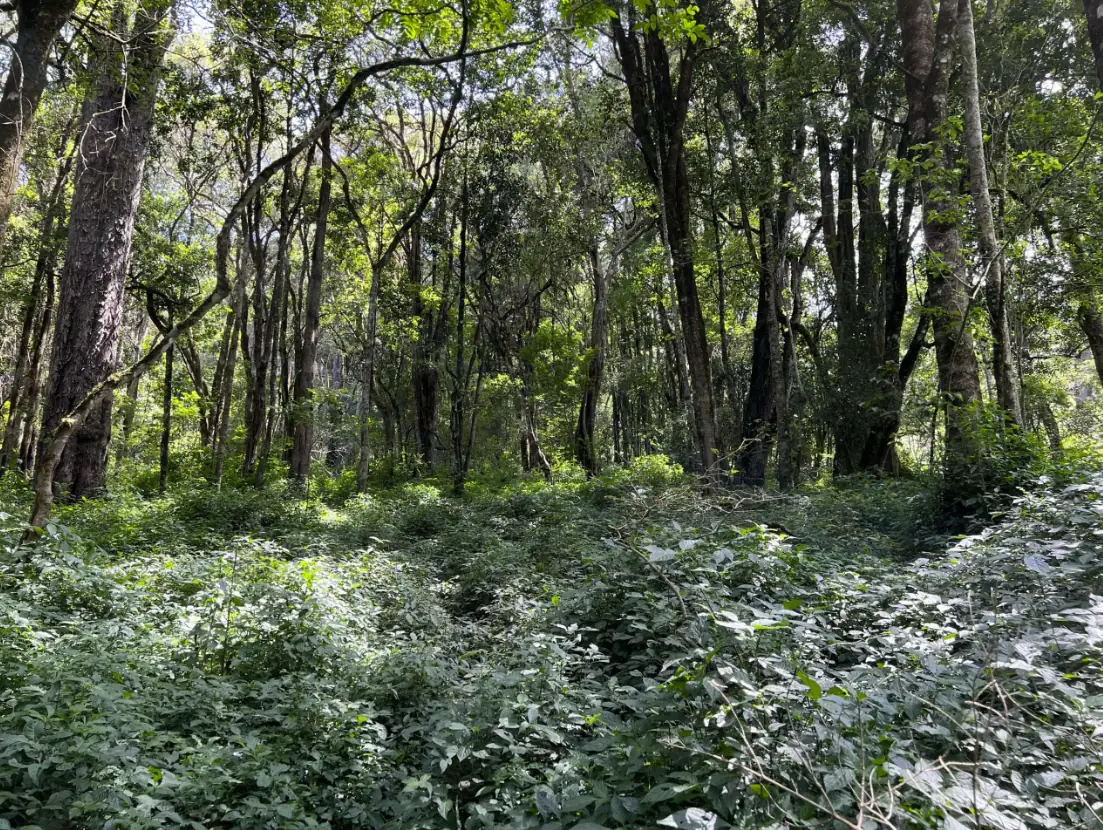
Degradation became noticeable around 1999, driven by settlement and farming, commercial timber, fencing of large tracts and emerging charcoal production.
Community governance
The forest has been governed by customary law. Researchers urge partnerships that strengthen the traditional institution rather than shifting power away from it.
Sources
Each entry shows the type of source, so you can judge how much weight to give it.
-
Peer-reviewedJournal article, 2021
A transforming traditional community based forest management: the case of Loita community forest, Kenya
Mbuvi, M. T. E. & Kungu, J. B. (2021). Heliyon, 7(6), e07380.
Shows the traditional Oloibon institution opening forest management to government and other stakeholders, driven by weakening leadership and forest degradation. Warns that powerful newcomers could reshape the rules, and calls for a gradual, inclusive process that strengthens the traditional institution.
Read the article (opens in a new tab) -
Peer-reviewedJournal article, 2023
Conserving the Sacred: Socially Innovative Efforts in the Loita Enaimina Enkiyio Forest in Kenya
Otieno, J. N., Bellotto, V., Esho, L. S. & Van den Broeck, P. (2023). Land, 12(9), 1706.
A qualitative case study using interviews, transect walks and focus groups. Finds that the forest is deeply embedded in Loita Maasai life and that the community uses its sacred practices to negotiate access, use and conservation, including through the Ilkimpa Community Conservation Association.
Read the article (opens in a new tab) -
Organisational reportWWF-Kenya
Elephants: Your Field Report, Issue 11
WWF-Kenya. Survey conducted by the Wildlife Research and Training Institute with WWF-Kenya support.
Describes a wet-season dung-count survey of elephants in Loita Forest, the method used, and pressures including drying rivers, farmland expansion, fences across migratory routes, overgrazing, logging and poaching.
Read the report (PDF, opens in a new tab)
Conservation glossary
Plain-language definitions for students, teachers and anyone new to conservation.
- Matriarch
- The older female who leads an elephant family group, guiding it to food and water using memory built over decades.
- Dung count
- A survey method that estimates elephant numbers from the number of dung piles, how often elephants produce them and how fast they decay. Used where elephants are hard to see.
- Wildlife corridor
- A route of habitat that lets animals move safely between larger areas.
- Human–elephant conflict
- Situations where elephants and people harm each other's interests, such as crop raiding or retaliation against elephants.
- Customary law
- Rules set and enforced by a community's own traditional institutions rather than by statute.
- Community conserved area
- Land or forest conserved by the community that lives with it, through its own governance.
- Endangered
- An IUCN Red List category for species facing a very high risk of extinction in the wild. The African savanna elephant is listed as Endangered.
Researching Loita?
If you are a researcher, student or institution interested in collaboration, tell us about your project, its methods and how findings will be shared with the community.
Send a research enquiry